
About Finalsite
Better tools. Stronger schools.
Finalsite is a software-as-a-service company that provides communications and content management solutions to educational institutions, particularly focused on K12 schools. In addition to their flagship content management system, Composer, Finalsite offers modules to help schools manage: calendars, forms, contacts, athletics, bulk email and text messaging, files, social media feeds, news and blogging, mobile apps, and more. While sites are designed and built internally with customized templates, and some content migration services may be included, clients are expected to use Finalsite’s tools independently after site launch.
Over the course of 7 years, and a period of explosive growth for the company, I worked to build scalable onboarding and product training opportunities for clients as well as Finalsite employees. From knowledge base articles and blog posts to recorded webinars and interactive video-based courses, I designed empowering learning experiences that helped multiple types of users make the most of their Finalsite tools.
Know your audience
Finalsite’s broad user base presented unique challenges for creating educational content to address their needs. A Finalsite user may be anyone from a teacher with no technical background building a form during her free period to a district IT administrator implementing sites for dozens of elementary, middle, and high schools. Finalsite’s granular user permissions allowed even parents and students to access Composer or any of its modules. Users’ needs varied widely depending on where they were in their journey, whether launching a new site, updating an existing one, or (often) taking over a site from a previous admin who didn’t leave adequate handover instructions. As a SaaS, Finalsite also released new features regularly (on a two-week agile cycle) that required additional training for even the most seasoned admins.
To ensure we were catering to our clients’ needs, whatever their background, I created three levels of user personas: User, Admin, and Superadmin. A User was someone who was creating content or using a module for its intended purpose, such as publishing a news article, sending a message, or building a form. They would almost never need to change the configuration settings for a module, which is where the Admin role comes in. Superadmin encompasses users still in the initial design (or redesign) phase and preparing for site launch, as well as district admins whose actions may impact multiple Composer instances. These roles are fluid, and a Superadmin may function as an Admin or even User the majority of the time.
Finalsite modules are occasionally replaced as better tools are developed, but adoption of these modules is not universal and support for older versions is necessary.
New and legacy modules frequently have overlapping features and similar names, which can be confusing to a Help Center user who wants information about one and lands on an article about the other. It’s necessary to keep the information available for clients still using the legacy module, but it’s difficult to surface the best content in search.
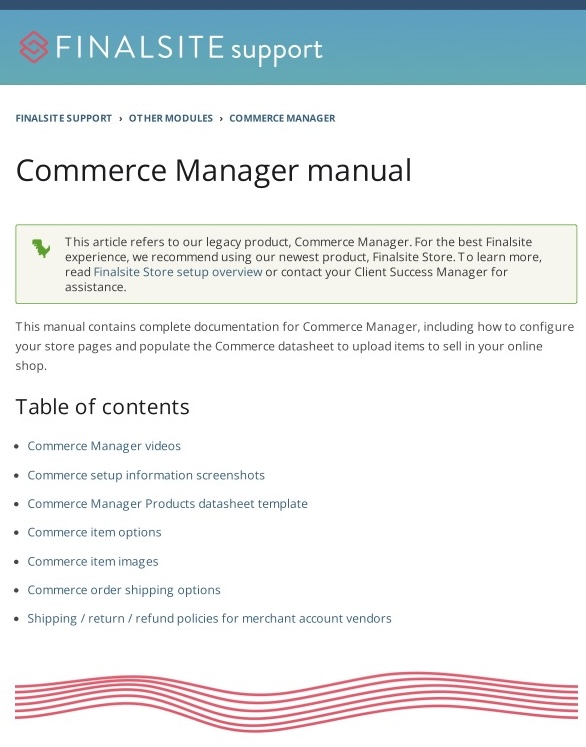
We explored various interim measures for making the legacy module content less visible, including consolidating the sections and putting the modules into a single “Other Modules” category. We added a note at the top of each article directing users to the newer module content, with the secondary goal of encouraging legacy users to convert. However, audit results revealed above-average views and high bounce rates on legacy articles, indicating that users were still struggling to find the best content.
The “module manual” presents all of the Support content for a legacy module within a single article with a table of contents at the top. Content is therefore still available and searchable, and Support agents can use the links in the table of contents to point clients to specific instructions when needed. The number of irrelevant search results is decreased for users of the new module, but the needs of legacy users are not ignored.
 Lauren B. Lentini